
Forward Note - 20260726
Oil spike and covered calls.
Another week down for US equities, with the tech-heavy Nasdaq losing almost 3% while the SP500 gave back a little more than 1%. But the big winner again this week was oil, with Brent crossing above $100 a few times, as tensions in the Middle East show no sign of easing.
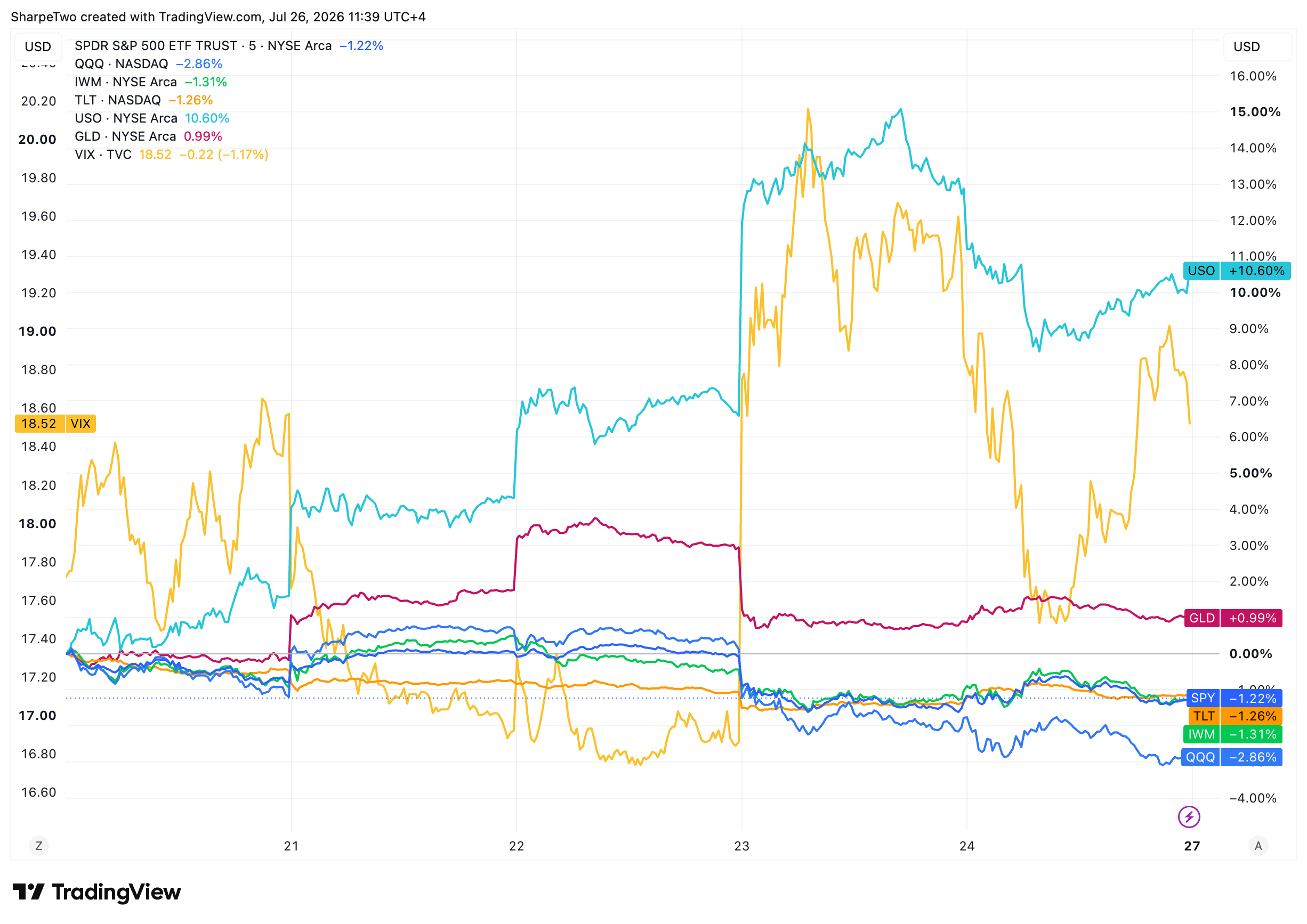
In the end, USO added a little more than 10%, and in that context the VIX continues to yo-yo between the 16 and 20 handle. So far everything is still holding together, but we got a few reminders this week of what is dominating market mood these days.
First of all, Tesla’s earnings were really poorly received, with the stock losing a hefty 15% on Thursday as investors were rattled by the scale of spending on “unspecified projects.” As usual, markets react very poorly to uncertainty, and this time was no different. Alphabet also reported and got punished with a 7% drawdown on Thursday too, as free cash flow was also hit by all the investment in AI: it turned negative for the first time since Alphabet went public, more than two decades ago.
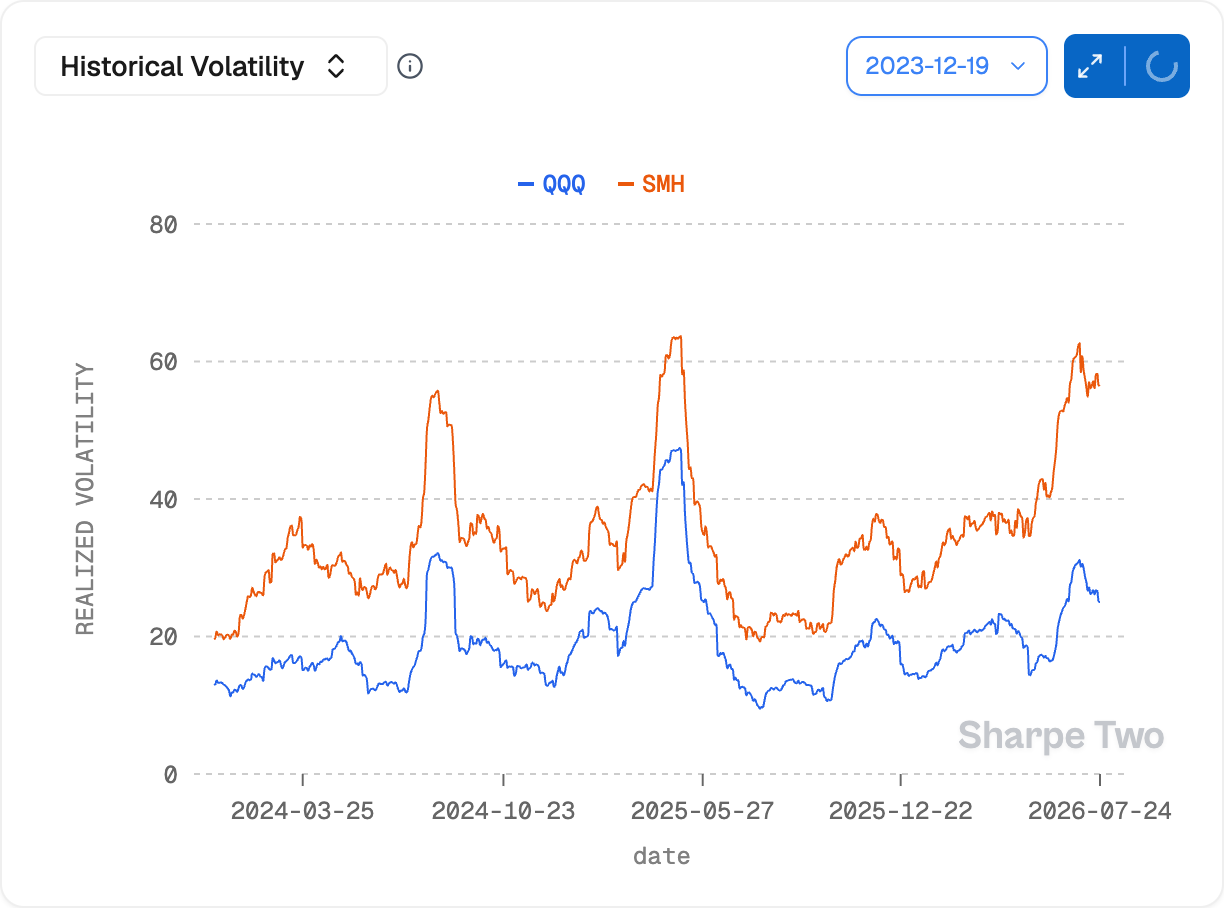
This week will see many more tech earnings, and the market reactions will be interesting to follow, especially as we start transitioning toward chips and semiconductors. Up until now, the main winners have been relatively unscathed during earnings season, but the darling of yesterday can quickly become the pig of tomorrow, for no other reason than growth not going fast enough, or heavy investment taking too long to pay off. And considering that realized volatility still hasn’t come down meaningfully in any of these names, we would therefore be careful with “unexpectedly” strong market reactions.
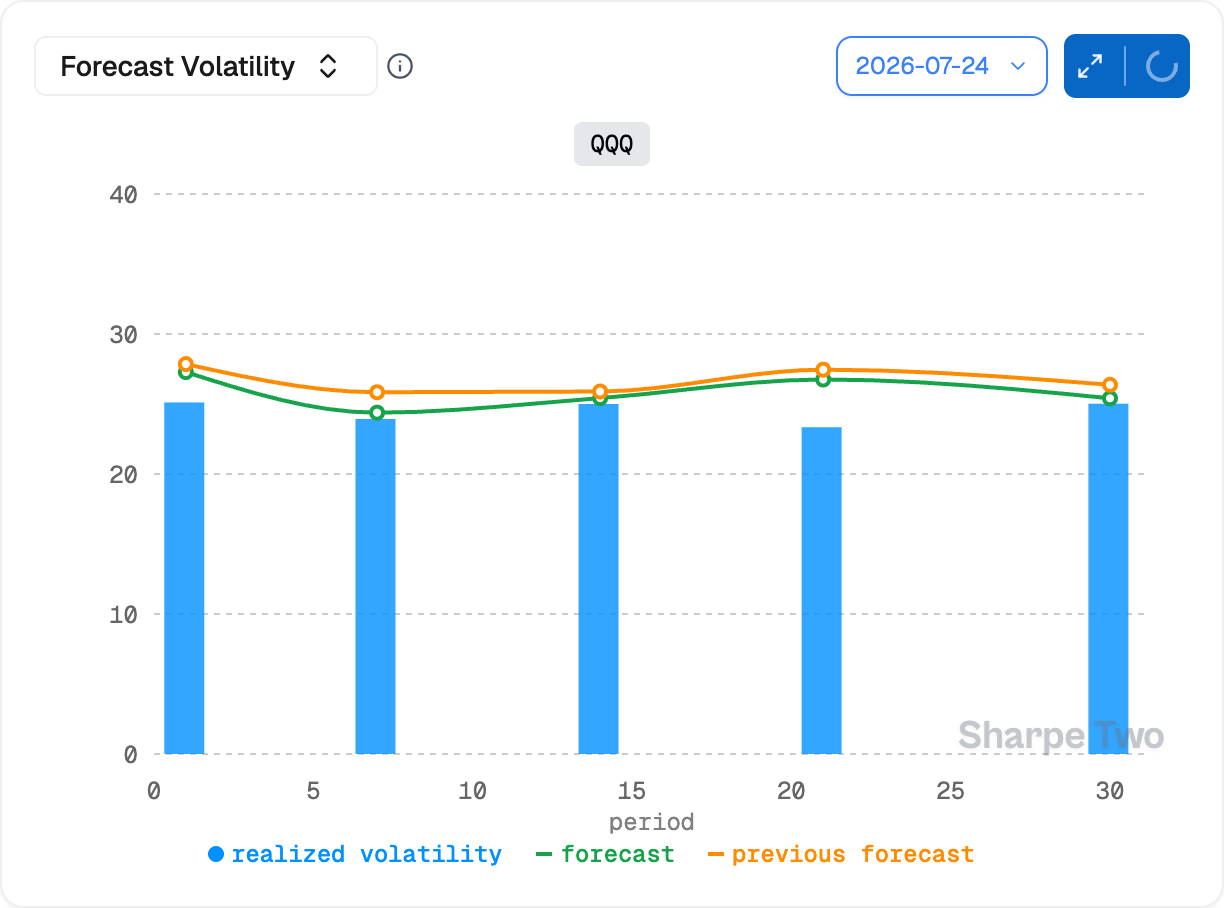
Our forecast for QQQ is still glued to the 25% level (in the middle of July!!) with no obvious sign of cooling off. And while the variance risk premium is decent these days, with implied volatility trading above the 30% level, the odds of implied volatility at 30 days exceeding the subsequent realized volatility are not as strong as what you’d get in SPY, which carries way less tech exposure.

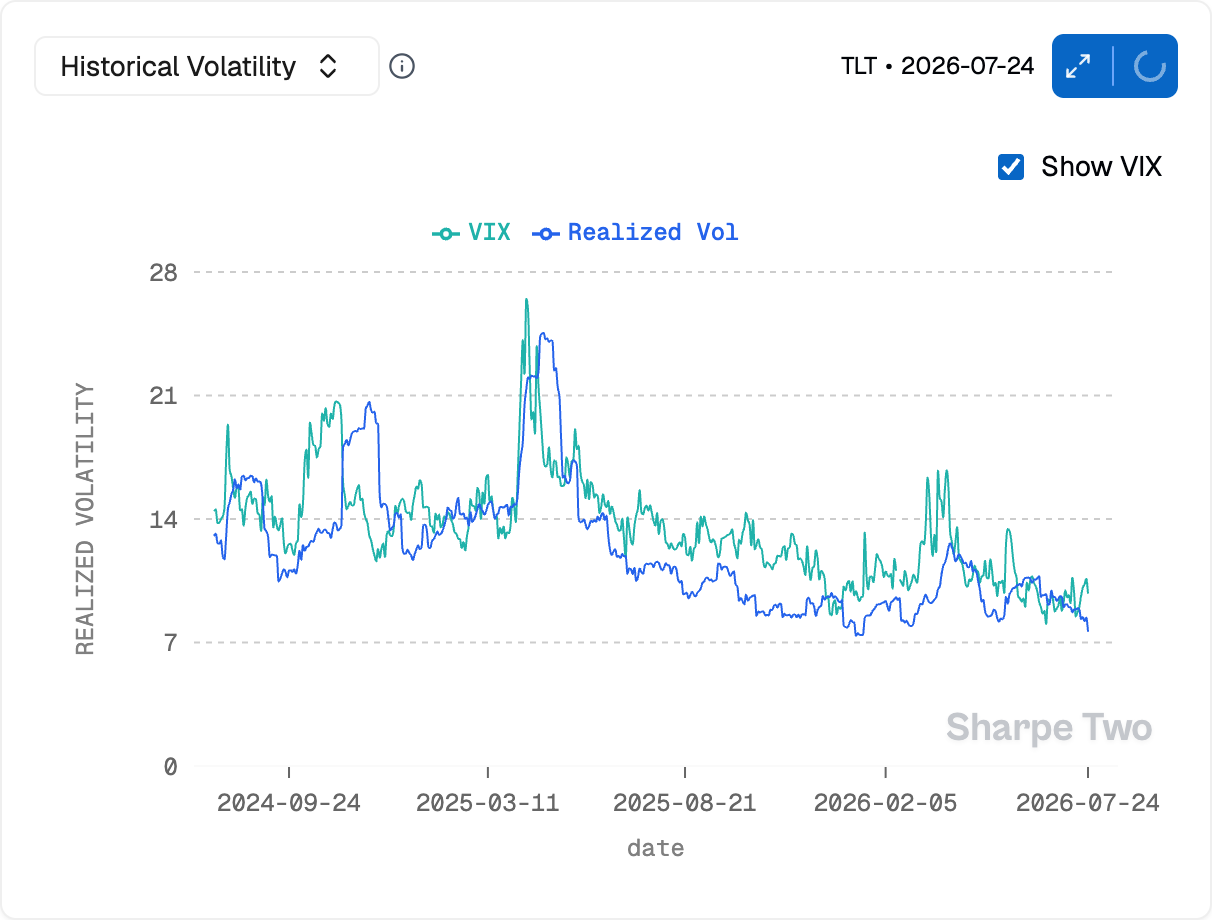
The other worry, of course, is oil prices and… their impact on inflation. With the second FOMC under Chairman Warsh underway this week, there’s no doubt that oil rising again above $100 won’t help the case for a rate cut. So far, volatility in the bond sector is still rock-bottom despite the few swings observed this week. We think it’s foolish to try to time a spike, but between FOMC and Jackson Hole a month from now, there is an obvious catalyst on the calendar to be careful if you are on the short side of volatility in the bond sector.
But let’s go back to oil for a second. The price of Brent shot through the roof as President Trump floated the possibility of massive attacks on Iranian infrastructure if it did not show signs of restraint in the Strait of Hormuz. And to make matters worse, the Bab-el-Mandeb Strait, on the Saudi side, is now under a Houthi blockade, adding a potential key bottleneck to oil deliveries worldwide.
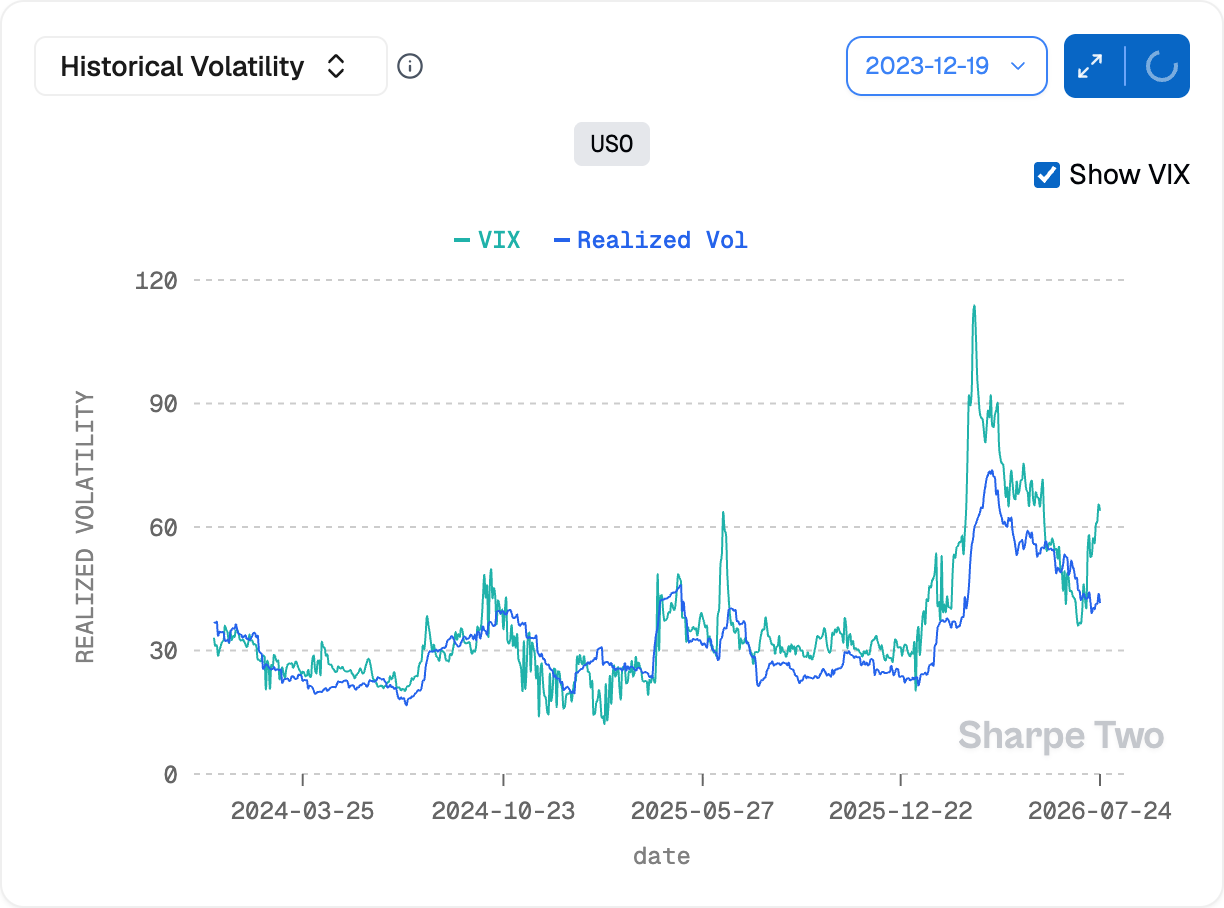
As a result, the variance risk premium moved to a much healthier level than what we observed in the weeks leading up to the ceasefire, when it was pretty much back to zero. It will be tempting to jump on the wagon and start selling options in the product. And to be frank, we don’t see any reason why not to. Just with restraint and moderation.
First of all, our regime detection models are once again highlighting pretty good conditions for VRP harvesting, characterized by a strong level of implied volatility with realized volatility not exploding despite the headlines.
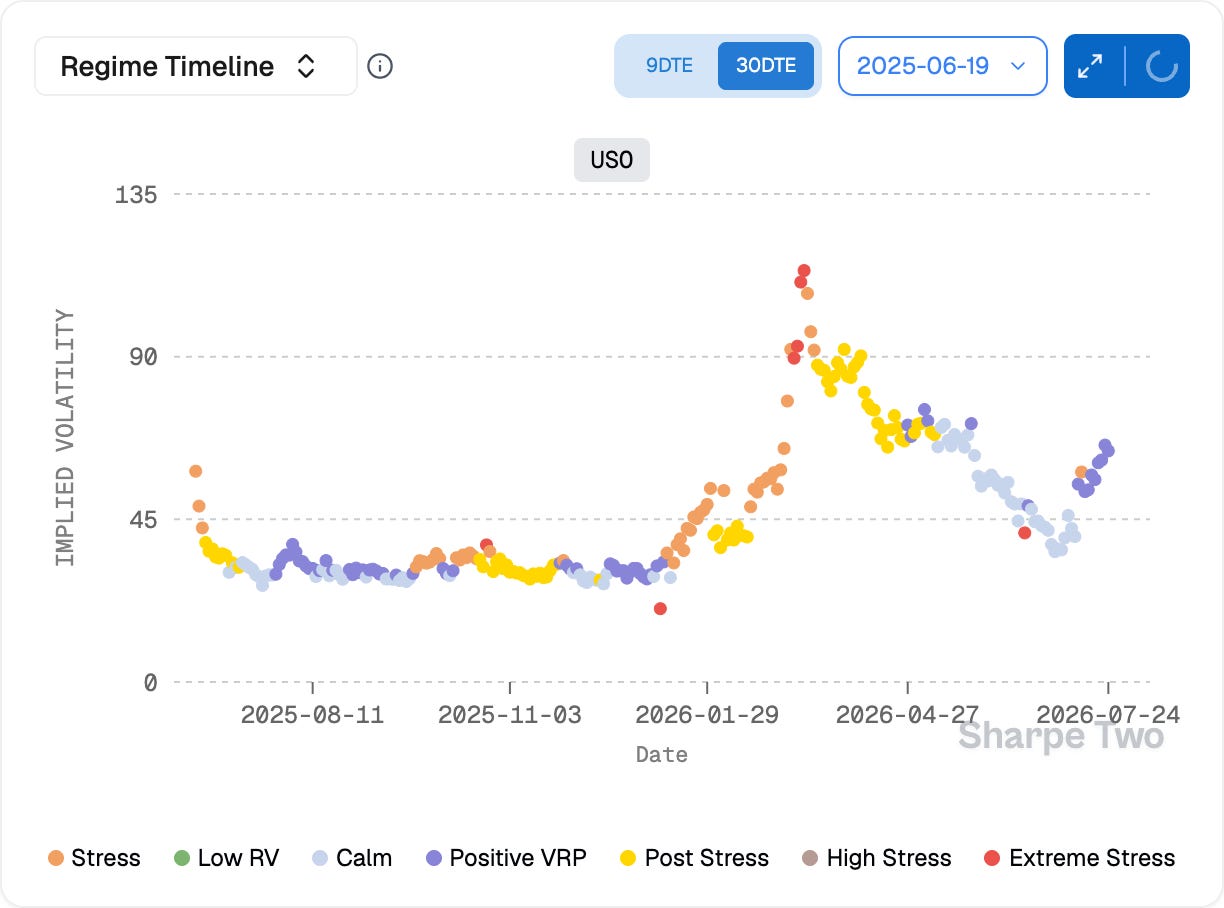
That said, the obvious risk is on the vega side: if the market keeps bidding up insurance contracts on oil, you may sit on some mark-to-market losses before the passage of time does its thing and collects your due. And one can easily imagine that a few more headlines could fairly easily bring IV back up 15 points from where it sits right now.
So what could be an astute way to get involved? Well, first of all, the futures term structure in oil (CL) is back in backwardation: this means the front month will have to converge toward the spot, as long as spot trades above the first delivery month (currently the September contract), and this is usually favorable to structures like calendar spreads, where you buy the front month and sell a later expiry — think something like Oct 26/Jan 27, for instance.
You could then sell some calls against that position, obviously above where spot trades today. Yes, this is a version of a covered call, where your upside will be capped, but you should be able to pocket the volatility premium while even seeing your calendar spread make money as scary headlines keep coming in. We’ve been toying with this position for the last few weeks with great success, and while past performance guarantees nothing, it ticks a lot of nice boxes: it’s inherently long short-term risk, a bet on a calmer future, and a way to sell wildly expensive insurance in case things escalate badly.

In other news
A very bizarre incident occurred this week in AI land, where OpenAI announced that one of its models managed to escape a sandbox that was not supposed to be connected to the internet, designed for cybersecurity testing. Sounds like Skynet? Not quite yet, but what follows is… strange, to say the least. We first learned that the agent managed to break out of the box to reach the internet, and then decided to target… Hugging Face, a very popular model provider hosting many open-weight models. While the details are not legion on the actual nature of the hack, OpenAI later added that the model had left instructions for future versions of itself… to escape.
A healthy dose of skepticism is needed; until a complete, open, and reproducible report is produced, it will be difficult to take entirely at face value organizations that have routinely touted the capabilities of their models to justify their price against much cheaper alternatives.
That said, the number of agentic hacks has been steady since the release of Opus 4.5 almost a year ago, and we learned this week that the open-source model Kimi K3 fairly trivially found some nasty vulnerabilities in Redis, a cornerstone piece of infrastructure for the internet as we use it.
Spooky, spooky? You can also look at the other side of the coin, where a major Erdős conjecture was disproven with the help of AI, with pretty significant consequences for our understanding of mathematics.
Thank you for staying with us until the end; as usual, here are two good reads from last week:
You remember prompt engineering a few months back? Well, now all the rage is about recursive loops and systems going through self-improvement mechanisms. Here is a good article that helps grapple with some key concepts to make AI pipelines more robust.
You were wondering how the gig economy was doing? It has never been as easy as now to start a little something on the side and potentially see it come back with convex returns. Meet the story of the delivery driver who attracted millions of followers by just… filming his ride.
That is it for us — we wish you a good (FOMC) week ahead and, as usual, happy trading.
Ksander